Showing posts sorted by relevance for query Montreal. Sort by date Show all posts

Tuesday, May 10, 2022

Montreal politicians debate whether to allow skyscrapers higher than Mount Royal

 https://montreal.ctvnews.ca/montreal-politicians-debate-whether-to-allow-skyscrapers-higher-than-mount-royal-1.5401429

Several cities have their agendas to hold back the urban environment. Montreal has been very reluctant to allow Toronto size buildings.

https://cultmtl.com/2021/05/in-defence-of-building-height-restrictions-in-montreal-mount-royal-urban-plan-denis-coderre/

Not only is Montreal forbidden to have anything tall enough to be impressive to NYC, but even by Paris & Melbourne standards. As land costs continue to rise, Montreal will have to seriously consider having a designated area for much taller buildings. London & Paris had to wrestle with this issue decades ago & are still thriving as financial as well as government capitals.

http://ville.montreal.qc.ca/portal/page?_dad=portal&_pageid=2762,3101387&_schema=PORTAL

Portland, Oregon also has its downtown next to a small mountain & like Montreal has used that as an excuse to forbid Seattle size towers.

https://www.cbc.ca/news/canada/montreal/find-out-how-this-rule-of-thumb-helped-shape-montreal-s-skyline-1.4950667

"In Montreal, municipal regulations forbid any building from exceeding the height of Mount Royal, or 233 m (764 ft) above mean sea level.[1] Above-ground height is further limited in most areas and a minority of the downtown land plots are allowed to contain buildings exceeding 120 metres in height.[2] The maximum limit is currently attained by 1000 de La Gauchetière and 1250 René-Lévesque, the latter of which is shorter, but built on higher ground. To build higher than 1000 de La Gauchetière while respecting this limit would be to build on the lowest part of downtown; the maximum height there would be approximately 210 metres.[2]

By contrast, Gatineau and Quebec City do not have building height restrictions." https://en.wikipedia.org/wiki/List_of_tallest_buildings_in_Quebec , https://en.wikipedia.org/wiki/List_of_tallest_buildings_in_Quebec#Tallest_under_construction_or_proposed

 While extremely restrictive Vancouver still won't permit any office building to even have a 40th floor, Montreal at least has one that has 51 floors.

https://wikipedia.org-1000-de-la-gauchetiere.jpg  205 m (673 ft) 

1000_de_La_Gauchetetiere is actually the tallest building in Montreal because it has a higher roof than 1250_Rene-Levesque. 

Architectural226.5 metres (743 ft)
Roof199 metres (653 ft)
https://wikimedia.org  A flagpole or antenna still doesn't make the roof as high as the tallest building in Montreal. 199 metres (653 ft)

Place_Ville_Marie is the widest of the tallest buildings in montreal. 188 m (617 ft)

In some ways Portland,_Oregon is more strict on the heights of office towers than Montreal is.
https://Portland_from_Pittock_Mansion_October_2019 , 

No 50 or 45 story office tower exists in Portland, just a 42 & another at 40 stories.

The Royal_Centre_in_Vancouver and the MNP_Tower have no 40th floor, because no office tower in BC has ever been allowed to have a 40th floor.

By now Vancouver should have been allowed to have at least one office tower over 50 stories like Montreal.
However, Vancouver still isn't allowed to even have a 40 story office tower.
So while this will be the tallest office building in Vancouver, it isn't by Portland & Montreal standards & those cities are notorious for being very limited on their building heights..

Tuesday, May 10, 2022

The Samuel De Champlain Bridge in Montreal

 https://en.wikipedia.org/wiki/Champlain_Bridge_(Montreal,_2019-present)

Being from Vancouver its hard to fathom that Montreal has this new cool 8 lane Champlain_Bridge. Then I remember that no one from Vancouver or BC was able to stop it from being built in Montreal. Of course the Vancouver mentality is to prevent any new wide bridge. In fact, to prevent any new bridges that would bring more cars and trucks into its puny city limits.

https://vancouver.skyrisecities.com/news/2017/05/sibling-bridges-second-narrows

Of course the new Champlain_Bridge would be designed to carry the REM line over the river. https://rem.info/en/work-schedule Simply because Vancouver is classified as a scenic city, its not allowed to have big city infrastructure on the scale of what Sydney, Australia, SF, Seattle & Montreal allow.

The Ironworkers_Memorial_Second_Narrows_Crossing should have been built with 4 or at least 2 wide shoulders so that by now, the bridge could have had 8 to 10 lanes. Plus a provision for 2 rapid train tracks & 2 express bus lanes on a lower level. Instead, its a congested mess of 6 lanes with no shoulders or provision for rapid transit. Unlike most cities, Vancouver really excels at congestive planing. That's why the first 2 Skytrain lines have stations only about half the length of any Montreal Metro station. The Canada line only has a maximum allowance for 50m stations, while the Montreal Metro has 152.5m stations.

https://globalnews.ca/news/8330542/pothole-ironworkers-memorial-bridge

Saturday, October 30, 2021

Montreal Metro Map Shows The Original Plans For Extensions

 https://www.mtlblog.com/montreal/this-montreal-metro-map-shows-the-original-plans-for-extensions--its-totally-different

Being from Vancouver, it's difficult to comprehend how Montreal and Quebec were able to fund and build such a big, good quality, high volume underground train system.

https://en.wikipedia.org/wiki/Montreal_Metro#History

https://www.stm.info/en/info/networks/metro

https://en.wikipedia.org/wiki/Montreal_Metro#Extensions_and_unbuilt_lines

https://upload.wikimedia.org/wikipedia/commons/thumb/e/e3/Lionel-groulx-montreal-metro.jpg/640px-Lionel-groulx-montreal-metro.jpg

Since Vancouver has taken a narrow roads and bridges approach, one would think that the SkyTrain would have been built with a provision to eventually have 500 foot long stations at 152.44m. Instead, the first 2 lines only have 80m long stations, while the 3rd line has absurd 50m short stations. 

https://dailyhive.com/vancouver/canada-line-skytrain

Even with budget limitations, the SkyTrain should have been designed for future_growth by allowing the space for much longer stations. Of course that wasn't a problem for Montreal, Toronto, Edmonton and Seattle...

Vancouver is about creating bottlenecks and congestive planning in general. It will be almost impossible to ever double or triple the length of any underground SkyTrain station.

https://dailyhive.com/vancouver/skytrain-metro-vancouver-expansion

Monday, January 31, 2022

Montreal-weather-heavy-snowfall-forecast

 https://dailyhive.com/montreal/montreal-weather-heavy-snowfall-forecast

Although it can get very cold at times, at lest the Montreal_Metro is built on a grand scale for a big city. Being from backward Vancouver, one can only imagine if the SkyTrain could have been built on a similar grand scale. All the SkyTrain stations should have been built with a future provision to have 500ft or 152.5m long platforms. https://en.wikipedia.org/wiki/SkyTrain_rolling_stock#Summary

Instead, the first 2 lines are just barely half the length of a Montreal station. The 3rd line was only built to ultimately have only 50m stations. Not even quite a 3rd of the length of a 152.5m Montreal Metro station. 

https://montrealgazette.com/news/local-news/metro-service-partially-disrupted-on-orange-line

https://www.mtlblog.com/montreal/this-montreal-metro-map-shows-the-median-condo-price-around-every-station-in-2021


Tuesday, January 18, 2022

Montreal is the 17th most expensive Canadian rental city

 https://dailyhive.com/montreal/montreal-expensive-canadian-rent-city-last-month

From a Vancouver perspective, Montreal gets taller buildings, better trains and roads and an overall better infrastructure for the money. Of course Vancouver usually has much more mild winter conditions. 

https://dailyhive.com/montreal/average-rent-prices-each-montreal-borough


Sunday, November 21, 2021

Vancouver SkyTrain

 SkyTrain Expo Line from Surrey https://www.youtube.com/watch?v=ebMoKQyYYfI

It's one thing to start out with short stations, but at least allow for the provision of Montreal Metro length stations that are 500 feet. Unfortunately, the first 2 Vancouver lines only have 80m long stations. While Montreal was able to build 152m long stations right from the start. Then the 3 line that goes to Richmond only has stunted 50m stations. There has been a long running sentiment in Vancouver that BC doesn't ever need or want to have a Montreal or Seattle size city. All one needs to do is look at the larger scale of infrastructure in Montreal & Seattle than whats permitted in little Vancouver.

Skytrain Ride from Columbia to Waterfront https://www.youtube.com/watch?v=FwI_aJMG17c

All the stations could have been built to around 152m or 153m to allow for future long trains, but apparently its better to have short congested trains to match the narrow road system. Its all about demonstrating a reluctance to build proper big city size infrastructure in Greater Vancouver. Since BC, an area that can contain the area of 23 Switzerlands or more than 3 times the area of Italy, it's almost like it doesn't want the world to know that. BC can't reduce the scale of infrastructure in Toronto, Montreal, Calgary & Edmonton, because they are all beyond the reach of the muli-generational Vancouver & Victoria power-structure. 

Skytrain from Coquitlam to Vancouver https://www.youtube.com/watch?v=mMo4JzAd5B4 

https://the-intersection-point.blogspot.com/search?q=SkyTrain

Tuesday, November 23, 2021

Nicomekl-river-bridge-and riverfront-park in Surrey, BC

 https://dailyhive.com/vancouver/nicomekl-river-bridge-riverfront-park

King_George_Boulevard should have a minimum of 6 lanes all the way through its length. That would make it a lot easier to have a couple of bus or HOV lanes. So much of BC just had a 1 lane each way wagon road mentality for so long. https://en.wikipedia.org/wiki/King_George_Boulevard#History So to even get to a point where there are 2 lanes each way frightens some people. Especially a multi-generational stubborn power-structure that doesn't want to encourage rapid growth. Since BC can't control immigration into Canada, the next best thing would be to build a wall to perpetuate the, KEEP THEM OUT agenda. Of course that would result in many challenges, so BC continually thwarts the size of its infrastructure. On a much larger scale, Canada has made sure that its nowhere near containing 1% of the worlds population. Yet in-spite of that, Toronto, Montreal, Calgary & Edmonton are all still able to build up larger infrastructure, because they don't have to contend with Vancouver & Victoria restrictions.

BC has such expertise in funneling traffic into a 3 lane crossing. Some people would just like it to remain as it is. 

https://www.google.com/maps/place/Surrey,+BC/@49.0692287,-122.8233335,184m/data=!3m1!1e3!4m5!3m4!1s0x5485dc034d3fa75b:0xd28b4898abd598e0!8m2!3d49.1913466!4d-122.8490125

https://www.google.com/maps/place/Surrey,+BC/@49.0692107,-122.820008,521m/data=!3m1!1e3!4m5!3m4!1s0x5485dc034d3fa75b:0xd28b4898abd598e0!8m2!3d49.1913466!4d-122.8490125


The quintessential 3 lane bottleneck.

https://www.google.com/maps/place/Lions+Gate+Bridge/@49.3154152,-123.1420283,2331m/data=!3m1!1e3!4m13!1m7!3m6!1s0x548673f143a94fb3:0xbb9196ea9b81f38b!2sVancouver,+BC!3b1!8m2!3d49.2827291!4d-123.1207375!3m4!1s0x548671e4314afbf5:0x3e51e1a4f59d56fa!8m2!3d49.3146651!4d-123.1392099


Of course the BC capital would have to have its own 3 lane bottleneck.

https://www.google.com/maps/place/Johnson+Street+Bridge/@48.428204,-123.3727534,249m/data=!3m1!1e3!4m13!1m7!3m6!1s0x548f738bddb06171:0x38e8f3741ebb48ed!2sVictoria,+BC!3b1!8m2!3d48.4284207!4d-123.3656444!3m4!1s0x548f749c9ec2d143:0x5a83be27f477e403!8m2!3d48.4282598!4d-123.3721465


If you are from Montreal or QC, it would be difficult to imagine something like a BC power-structure putting in a 3 lane crossing when it should at least have 6 lanes.

https://www.google.com/maps/place/Montreal,+QC/@45.4875674,-73.8697933,766m/data=!3m1!1e3!4m5!3m4!1s0x4cc91a541c64b70d:0x654e3138211fefef!8m2!3d45.5016889!4d-73.567256

Just imagine if this little 3 lane bridge was at a major crossing point in Montreal or QC.

https://www.google.com/maps/@45.4874563,-73.8679282,3a,60y,321.46h,85.09t/data=!3m6!1e1!3m4!1sbvDYhUmK9rVwp9NX8lpRhA!2e0!7i16384!8i8192

Montreal already has its share of congestion. If anyone there tried to impose BC bottleneck planning there it would be an outrage of protests.

Tuesday, December 07, 2021

Vancouver ranks 58th of top 100 destination cities around the world

 https://dailyhive.com/vancouver/vancouver-city-ranking-58-out-of-100

That's the problem with the backwater BC mentality. Why have Skytrain stations longer than the underground Edmonton LRT stations or even at the same length as the Toronto subway stations? Vancouver really should have allowed a provision to have 500 foot or 152.5m stations like the Montreal Metro has. Vancouver opted to have narrow bridges so that it's almost impossible to have proper bus & HOV lanes. 

Fortunately, Vancouver, BC wasn't able to stop Seattle & Portland, Calgary & Edmonton from having a zoo within their city limits. Of course Vancouver made sure that it never had a proper big city zoo within its city limits like equally small Boston & San_Francisco did. Boston, SF & Vancouver are all less than 50 sq.mi. or 130 sq.km in area. Yet, those cities were allowed to do so much more than Vancouver.

The lack of proper big city museums & art galleries fits right in with the small city mentality of Vancouver.

Its as if there has been a multi-generational mentality to keep Vancouver small & backward since its early years.

"The first viaduct was completed in 1915, extending what was then called Harris St over the CPR Beatty St yards to connect to Georgia St.  At that time, Harris St was renamed East Georgia, and the viaduct called the Hart McHarg bridge, but it was more commonly called the Georgia Harris Viaduct.  It was poorly built and plagued by difficulties from the beginning; It was not uncommon to see sagging sections, timber propping it up, and concrete falling to the ground below.  In anticipation of the viaduct and the planned streetcar providing easy access to the city centre, apartments began popping up in the area in the preceding years, including the heritage building called the Jackson Apartments at 660 Jackson St/501 E Georgia.  Although a track was laid for the Georgia Streetcar to offer service across the viaduct, there were immediate concerns about its ability to hold the weight, and the plan was abandoned." https://www.placesthatmatter.ca/location/georgia-st-viaduct (A fine example of inept Vancouver planning & development. So many other cities were actually able to build a bridge for streetcars or trams, as well as cars & trucks. 

https://vancouversun.com/news/local-news/this-week-in-history-the-great-georgia-harris-viaduct-opens-in-1915 (Why properly build infrastructure for long-range durability & future capacity?)

https://searcharchives.vancouver.ca/before-demolition-of-old-georgia-viaduct-30-9-70-4 If done properly, the original viaduct should have been built to be strong enough to have 6 lanes with 2 streetcar tracks & bike lanes. Then a lower deck provision for another rapid transit line with bike lanes. Fortunately, Vancouver wasn't able to stop other cities from getting rid of their streetcars or prevent the rebirth of tram trains.

https://en.wikipedia.org/wiki/Georgia_Viaduct#Demolition Some people believed that with proper strengthening & maintenance, they could have remained for several more decades. Perhaps even past 2070.

https://thetyee.ca/News/2018/06/27/Vancouver-Inner-City-Slum-Clearance-Repair (While the cancellation of a freeway through East Vancouver was a good idea in the 1960s, since the 1970s viaducts were built, they should remain for several more decades.)

To allow Vancouver to have the infrastructure of Montreal or Seattle would mean to fully accept becoming a major metropolitan area. 

https://en.wikipedia.org/wiki/Champlain_Bridge_(Montreal,_2019-present) An 8 lane bride with a provision for a rapid transit train. https://dailyhive.com/montreal/montreal-light-rail-train-rem-video

https://en.wikipedia.org/wiki/Interstate_90_floating_bridges Seattle has this as an 8 lane crossing with an LRT line as well. Unfortunately, such big city infrastructure just isn't allowed by the small city mentality of Vancouver.

If Vancouver, BC was allowed to become a major global city like Sydney, Australia or SF, California, the local power-structure would have to give up on its stunting agenda. 

A national power-structure has made sure that Canada has yet to even contain 0.005% of the worlds population. It just so happens that most of the world is non-white, but as long as Canada doesn't officially have a, KEEP THEM OUT agenda, the worlds 2nd largest nation won't even have 40 million people, when the world reaches 8 billion.

Saturday, October 30, 2021

Should The North Shore of Vancouver be next for rapid rail transit?

 https://dailyhive.com/vancouver/north-shore-rapid-transit-linda-buchanan

Of course there should be a passenger train to the North_Shore. Especially since this won't be turned into a 6 or 8 lane crossing and this won't be turned into a 10 or 12 lane crossing. 

A 2 car east-west Skytrain on the Millennium_Line is a sad joke but it can be lengthened to a 5 car train. Perhaps after some lengthening of the platforms the first 2 SkyTrain lines might be able to accommodate 6 or 7 car trains. Unfortunately, the Vancouver and BC mentality never allowed for the potential of 10 to 12 car trains. That's what happens when the stations on the first 2 lines are barely more than half the length of a Montreal Metro station.

Unfortunately, the Canada_Line_Trains and stations were only designed to be 50m when the Montreal Metro stations are 152.44m.  
https://dailyhive.com/vancouver/canada-line-skytrain 

"Unlike Bombardier ART trains, the Hyundai Rotem trains will not be operated as longer four- or six-car trains. Through inserting a middle "C" car at the articulated joint between two end cars, available capacity will be similar to a four-car Mark II or a six-car Mark I train. The Canada Line's station platforms are expandable to 50 metres (160 ft) in length to accommodate these future three-car trains; the five busiest stations are already 50 metres (160 ft) in length. The Canada Line has a designed future capacity of 15,000 pphpd when operating three-car trains at two-minute headways."

Some day, perhaps some proper big city planners and engineers will have to try to turn an absurd 3 car train into a 5 car train. This configuration would mean that only the 3 middle cars of a 5 car train would have doors that open onto the station platform. Another way of looking at it would be like having an extra 25m of train at either end of the 50m station. This would at least allow for a 100m or 328 foot long train. It's still a far cry from a 500 ft long Montreal Metro train.
https://upload.wikimedia.org/pg/640px-MPM-10_Azur_leaving_station.jpg
An old and new Montreal Metro train.

Its almost like there is an unwritten rule that Vancouver isn't suppose to build proper big city size infrastructure.

Saturday, March 13, 2021

The miniature Vancouver agenda

 https://www.urbanyvr.com/vantage-miniature-vancouver That's just how some people would like to keep Vancouver, as a little toy city.

A multi-generational miniaturizing or thwarting process started in Vancouver several decades ago. Essentially a white power-structure wanted to create so many overlapping municipal restrictions in order to dramatically slow the growth of the city. By refusing to build up proper big city infrastructure, Vancouver continually demonstrates its reluctance to act like a big city. Vancouver is one of the smallest major cities on earth. However, the BC Lower_Mainland could contain, Greater_Montreal , the Calgary_Metropolitan_Region , the Edmonton_Metropolitan_Region and Winnipeg. So a clever way was devised to keep the region from becoming another Toronto or Montreal or even like Seattle or any other major urban region that people want to move to.

The result is having short & congested trains when many cities allow 8 to 10 car trains. Having narrow bridges & roads to increase congestion & frustration. Buildings are kept short, despite the high cost of land.

Vancouver & BC is all about keeping people out, but since a force force field can't be established around BC, something else was done. Just keep limiting or restricting the size of the overall infrastructure & hope that no one notices. That's what the predominantly white power-structure still wants. Of course if they openly revealed their agenda, there just might be a multicultural movement that would demand that Vancouver start to behave more like all the big cities in Canada. That BC allow for significant growth. Switzerland can fit into BC about 23 times. Yet, BC has yet to reach the population of one Switzerland. 

Unfortunately at this point, its become quite evident that unlike most major cities, Vancouver still refuses to build up proper big city infrastructure.

At least its interesting to see what other major cities are able to do, simply because they aren't under the planning & building restrictions of Vancouver.

https://en.wikipedia.org/wiki/Montreal#Transportation Mon. & To. flourish in part, because they aren't under any type of small Vancouver or BC building limitations.

https://en.wikipedia.org/wiki/Toronto#Transportation It would be like a Sci-Fi horror story if Vancouver was able to force Toronto & Montreal to only have 4 lane roads & short trains with only 2 - 4 rail-coaches. Fortunately, Vancouver & BC in general, were unable to change the mentality of Toronto & Montreal. Even much closer Seattle & Calgary are able to have much wider roads than what Vancouver allows.

https://en.wikipedia.org/wiki/Calgary#Infrastructure

"Construction is underway on the final two legs of the freeway in west and southwest Calgary; both legs have been divided into north and south projects. The time-sensitive northern segment of the southwest leg will be completed first, following a land transfer agreement[42] with the Tsuu T'ina First Nation that was reached in 2013. It is being built as a 6-8 lane freeway to be completed by October 1, 2021,[43] with the ability to upgrade the corridor to a 16-lane freeway with express and collector lanes." https://en.wikipedia.org/wiki/Stoney_Trail#Future (In Vancouver, its like the roads can't be any wider than what Lethbridge has.)

"In late 2020 the Government of Alberta announced they will replace the existing eastbound bridge over the Bow River on Southeast Stoney Trail, widen the westbound bridge and build a new, stand-alone pedestrian bridge. The project will boost the number of lanes to four in each direction — currently the eastbound crossing has two lanes, while the westbound has three." https://en.wikipedia.org/wiki/Stoney_Trail#Future (Calgary actually will build a pedestrian bridge so that road lanes don't have to be reduced.The Vancouver approach is to avoid building pedestrian & bike bridges, opting instead to reduce lanes of traffic. This bottleneck planning approach ensures the best way to achieve even more congestion. So far, no one from Vancouver or BC has been able to get Albertans to go back to the horse & biggie days. Or, to simply ban most vehicles & force most people to go on bikes, skateboards or roller-blades, in addition to public transit. A good transportation system means having longer trains, wider roads & more bike & foot bridges to not reduce traffic lanes.) 

https://en.wikipedia.org/wiki/Calgary_Metropolitan_Region#/media/File:Calgary_Skyline_2015.png 4 lanes each way with 2 C Train tracks in the middle. 

The closest attempt in Greater Vancouver is in Burnaby. Only because the train is elevated, there might be a potential to have 4 lanes each way. https://en.wikipedia.org/wiki/Brentwood_Town_Centre_station#/media/File:Brentwood_Skytrain_long-exposure.jpg However, like in Vancouver, its tough enough just to have 3 lanes each way. https://en.wikipedia.org/wiki/British_Columbia_Highway_7#/media/File:Lougheed_Hwy_near_Brentwood_Stn.JPG

British_Columbia_Highway_7 doesn't have to be upgraded to a freeway, but most of it should have been 8 lanes wide by now.


https://en.wikipedia.org/wiki/Edmonton#Infrastructure

"The entire freeway road was built with expansion in mind; almost all bridges were built wide enough for expansion to the ultimate stage which includes as many as six main travel lanes in one direction, depending on location." https://en.wikipedia.org/wiki/Anthony_Henday_Drive#Future (A potential of 6 lanes each way in Edmonton. In Vancouver, its tough enough to have streets that are 6 lanes wide.)

https://en.wikipedia.org/wiki/Edmonton_Transit_Service#LRT

https://en.wikipedia.org/wiki/Red_Deer,_Alberta Two parallel bridges that allow for 3 lanes each way. Not a big deal for RD, but for Vancouver the power-structure doesn't even like more than 2 lanes each way.

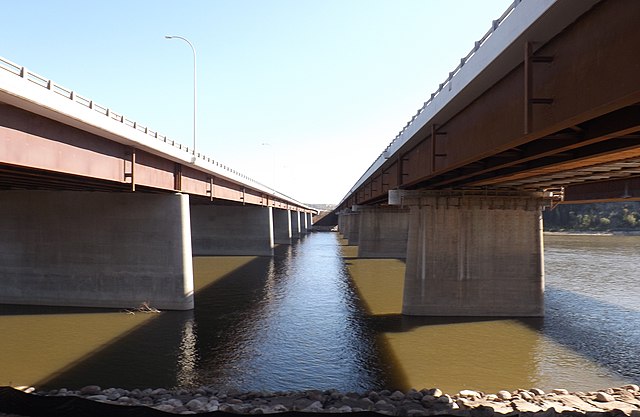
https://upload.wikimedia.org/wikipedia/commons/thumb/8/8b/Fort_McMurray_Athabasca_River_Bridges.jpg/640px-Fort_McMurray_Athabasca_River_Bridges.jpg Many cities will have parallel bridges less than a block apart. This is a way to add capacity to the overall crossing. In Vancouver this is frowned upon. In stead of increasing capacity, the crossings are kept narrow & sometimes even a lane or 2 is removed. This really helps to increase congestion, but that's whats expected with bottleneck planning. 
https://upload.wikimedia.org/wikipedia/commons/thumb/8/86/Fort_McMurray_Athabasca_River_Bridges_2.png/640px-Fort_McMurray_Athabasca_River_Bridges_2.png Vancouver has taken measures to prevent it from ever having any bridge or overall crossing from containing 10 lanes as in Ft. McM.
https://upload.wikimedia.org/wikipedia/commons/thumb/1/11/Surrey_aerial_view.JPG/640px-Surrey_aerial_view.JPG However, Vancouver was unable to stop Surrey from having a 10 lane crossing. 
No predominantly white power-structure is able to stop the growth of Surrey. No power-structure will be able to stop Surrey from eventually becoming the largest city in BC, with some of its tallest buildings. 

Most of the worlds population is nonwhite, so any slow growth initiative is a secret clever way to maintain the, KEEP THEM OUT mentality. A true multicultural Canada can help Vancouver & Victoria become proper big cities in the mild part of Canada. Not everyone wants to endure -20C to -40C winters.

Sunday, September 26, 2021